The Copper Crunch is the emerging structural copper supply gap: planned demand from AI, power grids, electrification, manufacturing and defense is expanding beyond the mine supply and recycling capacity projected to be available. The gap is quantified in published research, not merely inferred from commodity-market sentiment. S&P Global projects demand growing from about 28 million tonnes in 2025 to 42 million tonnes by 2040, with a potential 10-million-tonne annual supply shortfall unless supply expands materially. The International Energy Agency's latest assessment points to an approximately 25% shortfall between projected copper mine supply and primary supply requirements in 2035 under its stated-policies scenario. These forecasts measure different quantities and cannot be added together. S&P Global, January 2026 · IEA, July 2026
A single announcement can change the demand outlook for an entire region. Meta is scaling a five-gigawatt AI supercluster in Louisiana. Amazon has announced 2.4 gigawatts of additional data-center capacity in northern Indiana. OpenAI and its partners have targeted a ten-gigawatt U.S. Stargate buildout. CoreWeave's Pennsylvania project starts at 100 megawatts, with room to triple. A megawatt here or a gigawatt there might look like an electricity-industry statistic. For the global copper market, it is a procurement order waiting to happen. Meta Engineering · Amazon · OpenAI · CoreWeave
Copper runs through the power systems behind these projects: substations, transformers, distribution cables, backup equipment, cooling systems, motors and many of the components connecting a building to the electricity grid. S&P Global estimates around 44 metric tonnes of copper per megawatt for one high-intensity AI training-center design. At that rate, a gigawatt-scale project points to 44,000 tonnes of copper before different project boundaries and broader grid needs are considered. S&P Global, 2026
Now multiply the numbers. Forty gigawatts of comparable infrastructure would imply 1.76 million tonnes of copper under the 44-tonne assumption, or 2 million tonnes at the upper illustrative benchmark of 50 tonnes per megawatt. That is a scenario, not a tally of purchase orders. But it shows why the acceleration of AI infrastructure has become an industrial metals story, not merely a technology story.
There is a second problem beneath the geological one. Mining investment has long lead times, production is geographically concentrated and the commodity's journey from discovery to financed project to industrial customer still depends on fragmented documentation and layers of intermediation. More mines, processing and recycling are indispensable. So is a way to direct capital toward credible supply sooner.
"The copper exists. The demand exists. The capital exists. What is missing is a better market between them."
The Copper Crunch is therefore both a measurable future supply deficit and a challenge to the way the world finances, verifies and trades the commodities on which its industrial ambitions depend.
Why the modern economy runs on copper
Copper has been used for thousands of years, but its importance is accelerating. Few widely used metals combine electrical conductivity, thermal conductivity, ductility, durability, corrosion resistance, repairability and recyclability as effectively. These properties make copper fundamental to equipment that generates electricity, moves electricity, transforms voltage, powers motors, carries data, and cools increasingly dense electronic systems.
According to the U.S. Geological Survey, electrical uses, including power transmission and generation, building wiring, telecommunications and electronic products, account for roughly three-quarters of total copper use. That is why the copper story cannot be reduced to electric cars or solar panels. It includes buildings, substations, transformers, factories, railways, ships, machine tools, refrigeration, communications and the ordinary expansion of electricity access in growing economies. USGS: Copper Statistics and Information
The most important copper-demand drivers overlap:
-
Electricity grids: transformers, busbars, underground cables, distribution networks, switchgear and grid reinforcement.
-
Artificial intelligence: data-center electrical infrastructure, high-density computing, power distribution, cooling and new generation and transmission capacity.
-
Transportation: motors, charging networks, electric vehicles, rail, ports and logistics equipment.
-
Energy and industry: wind turbines, solar installations, batteries, industrial automation, process electrification and factories.
-
Security and defense: shipbuilding, communications, radar, missiles, drones, vehicles and resilient infrastructure.
The latest S&P Global study estimates that electric vehicles use about 2.9 times as much copper as comparable conventional vehicles. But the report also stresses that the largest demand drivers remain traditional economic activity and expanding energy systems. The Copper Crunch is a whole-economy issue, not a single-technology bet. S&P Global
A documented gap between demand and future supply
The clearest starting point is the gap between where demand stands and where the major research houses expect it to go.
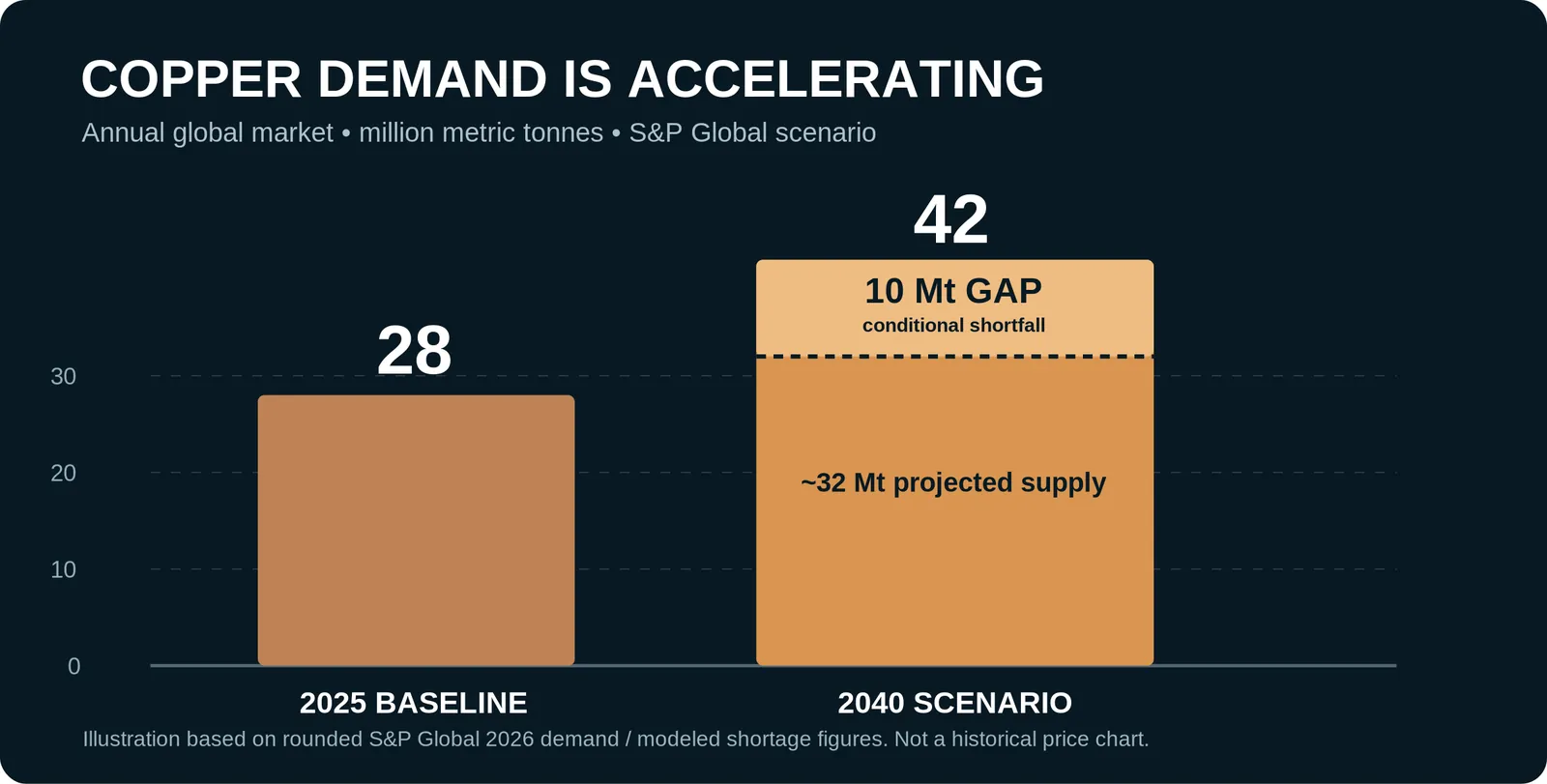
S&P Global's Copper in the Age of AI: Challenges of Electrification forecasts a 50% increase in annual demand from 2025 to 2040. Under its constrained-supply scenario, around 42 million tonnes of demand would confront only about 32 million tonnes of available supply, including recycling. Its analysis envisages additional recycled supply, but not enough to close the modeled gap. S&P Global study · S&P Global press release, January 8, 2026
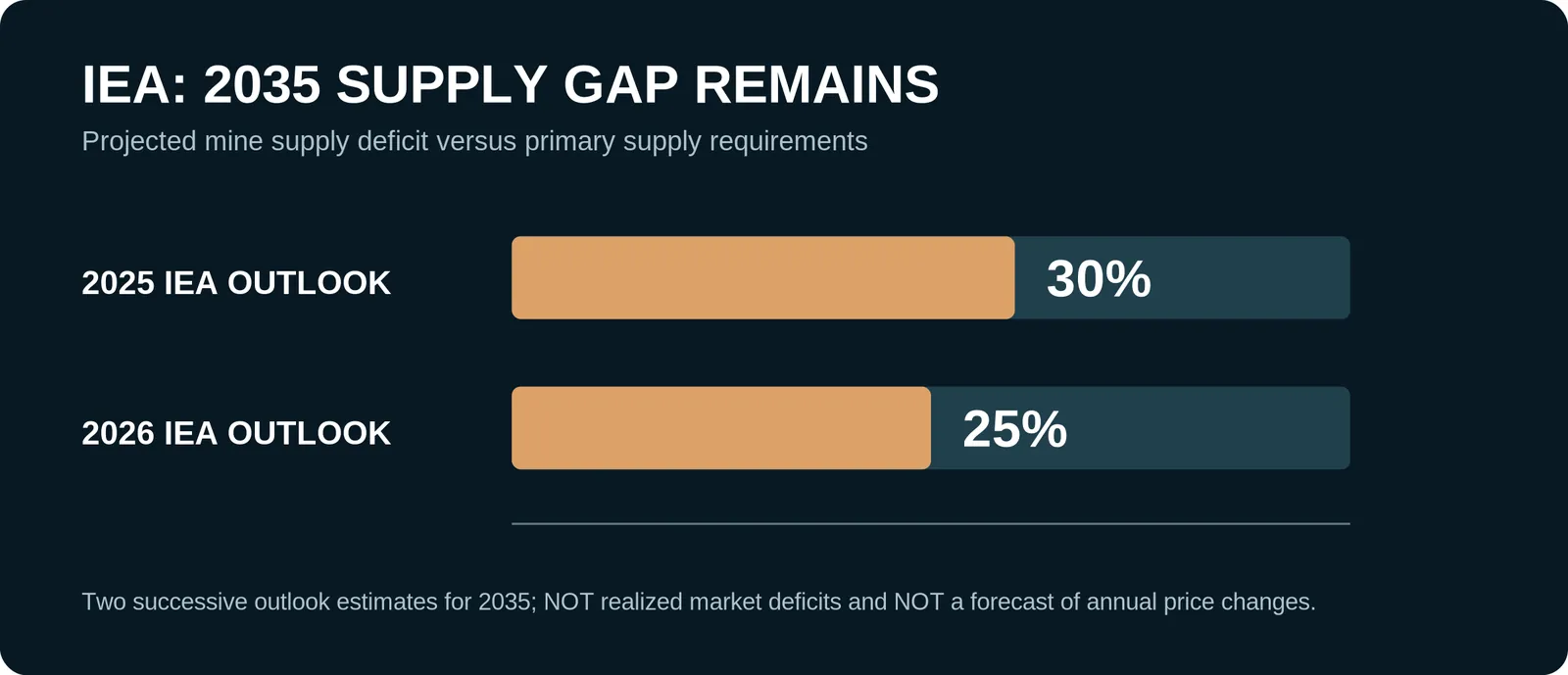
The IEA reaches a similar strategic warning through a different method. In its 2025 outlook, the agency estimated a 30% potential copper mine-supply gap by 2035. Its updated 2026 outlook narrowed that estimate to 25%, reflecting progress on projects, particularly in the Democratic Republic of the Congo and Zambia. This improvement matters: supply can respond to investment and policy. Yet even after the revision, the expected project pipeline remains insufficient in the stated-policies case. IEA 2025 outlook · IEA 2026 executive summary
A critical distinction: mine production, refined copper, apparent consumption and total copper demand are not interchangeable series. Mine output refers to primary metal extracted from ore. Refined supply includes processed metal and may involve secondary feedstock. Total consumption can include recycled metal. A shortage in a future scenario must be read with the model's definition, recycling assumptions, project pipeline and time horizon.
The twenty-year copper equation
A prominent illustration from the October 2026 TOKEN2049 presentation shows 700 million tonnes of projected copper requirements over roughly 20 years, compared with an estimate of historical mine output of a similar order of magnitude.
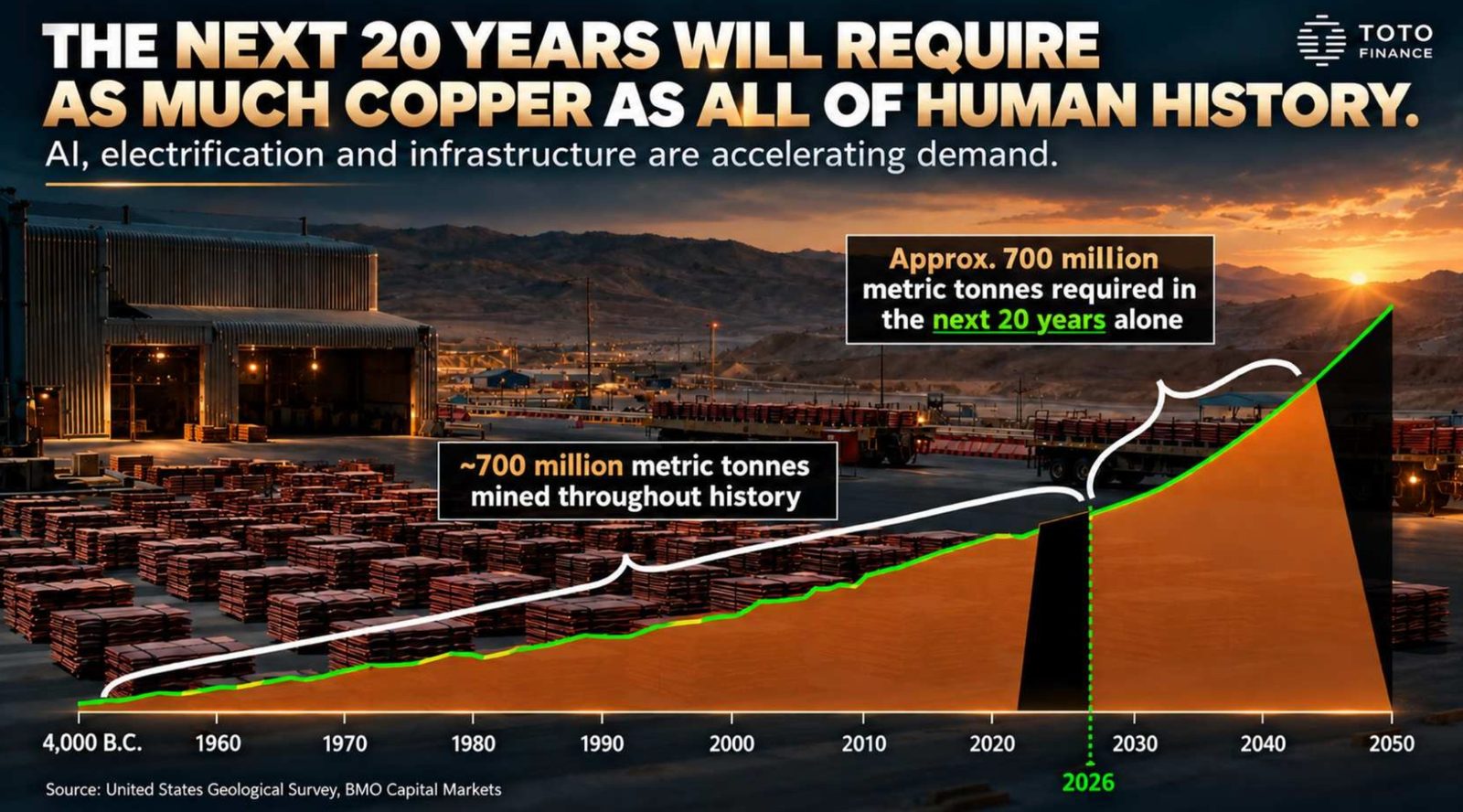
The arithmetic illustrates the order of magnitude: an economy consuming an average of 35 million tonnes a year would use about 700 million tonnes in twenty years. What requires caution is the historical comparison. A single, consistently defined USGS cumulative total matching that graphic has not been established here; nor can total future demand automatically be equated with future new mine output. The headline makes a powerful point about magnitude. The rigorously sourced conclusions come from the S&P Global and IEA forecasts above.
AI data centers are becoming a major copper consumer
The scale of AI infrastructure investment has pushed data centers into a category once associated mainly with power stations and heavy industry. To operate a dense AI computing cluster, developers must secure not just servers and GPUs, but continuous electrical capacity, high-voltage connections, transformers, distribution systems, cooling equipment and backup power. Copper is integral to those systems because it carries electricity efficiently and transfers heat effectively.
The IEA projects global data-center electricity consumption more than doubling to approximately 945 terawatt-hours a year by 2030 in its base case. That measures energy consumed over a year, not a data center's peak electrical capacity. By contrast, a 100 MW or 1 GW campus describes power capacity. Confusing megawatts, gigawatts and terawatts exaggerates the scale and obscures a real, exceptionally large investment wave. IEA, 2025
S&P Global's January 2026 research is unusually useful because it estimates how much copper sits inside different types of data centers. Its modeled high-intensity AI training campus requires 44 tonnes of copper per MW; a Chinese AI-training configuration reaches 47 tonnes per MW, while a broader range for non-cryptocurrency data centers is approximately 30 to 40 tonnes per MW. The differences depend on facility design, electrical redundancies, cooling, grid connections and equipment choices. S&P Global, 2026
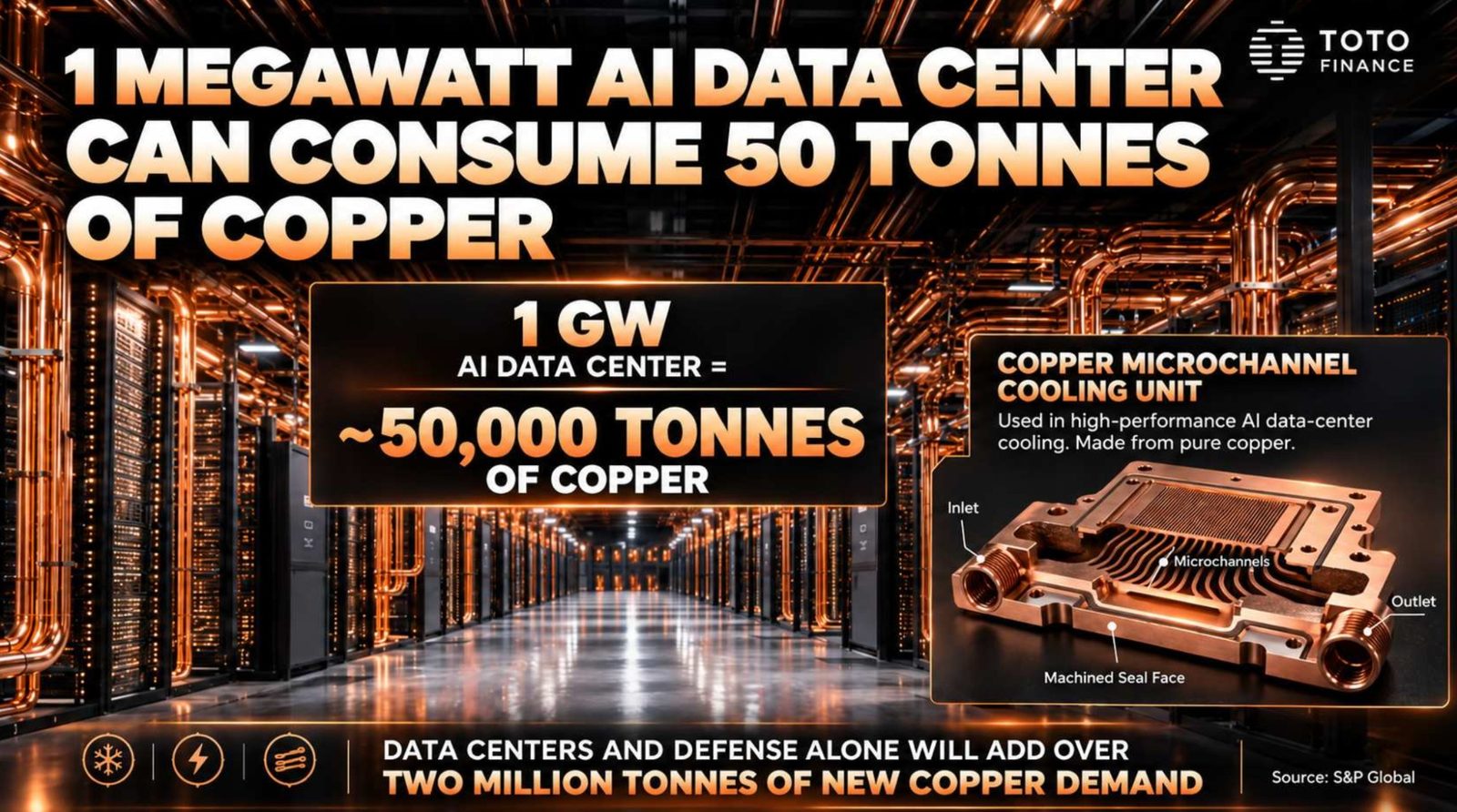
Yes, a one-gigawatt AI data-center complex can be associated with tens of thousands of tonnes of copper, potentially around 50,000 tonnes under a high-intensity scenario. In S&P Global's published example, a 230 MW AI training facility at 44 tonnes per MW consumes approximately 10,000 tonnes of copper in its power, cooling and connectivity systems. That is why the headline figure should be treated seriously, while remaining a design-dependent estimate rather than a universal engineering constant.
The projects moving from announcements to construction
The biggest announcements are no longer isolated 20 MW computer rooms. They are power-intensive campuses whose capacity rivals major industrial facilities. The figures below come from company disclosures, not estimates of how many facilities will ultimately be delivered on schedule.
| Announced project | Announced power scale | Illustrative copper at 44 t/MW | Source and status |
|---|---|---|---|
| CoreWeave, Lancaster, Pennsylvania | 100 MW initially; possible 300 MW | 4,400 tonnes initially | July 2025 company announcement; expansion conditional |
| Meta Prometheus, New Albany, Ohio | 1 GW | 44,000 tonnes | Meta engineering disclosures; first phase reported complete October 2026 |
| Amazon, northern Indiana expansion | 2.4 GW | 105,600 tonnes | November 2025 announced additional data-center capacity |
| Meta Hyperion, Louisiana | Up to 5 GW | Up to 220,000 tonnes | Meta says the campus can scale to 5 GW after phased development |
| OpenAI Stargate, U.S. program | 10 GW long-term ambition | 440,000 tonnes if fully developed | U.S. program target; includes Oracle and other partner sites |
Table note: The estimates multiply announced capacity by S&P Global's 44 t/MW high-intensity example. They are illustrations, not company disclosures of copper orders or a claim that all five developments have identical engineering. The Stargate umbrella includes partner projects, so announced Oracle or CoreWeave projects should not be added to the Stargate total without checking overlap. The projects span multiple years and phases. CoreWeave · Meta · Meta, October 2026 · Amazon · OpenAI
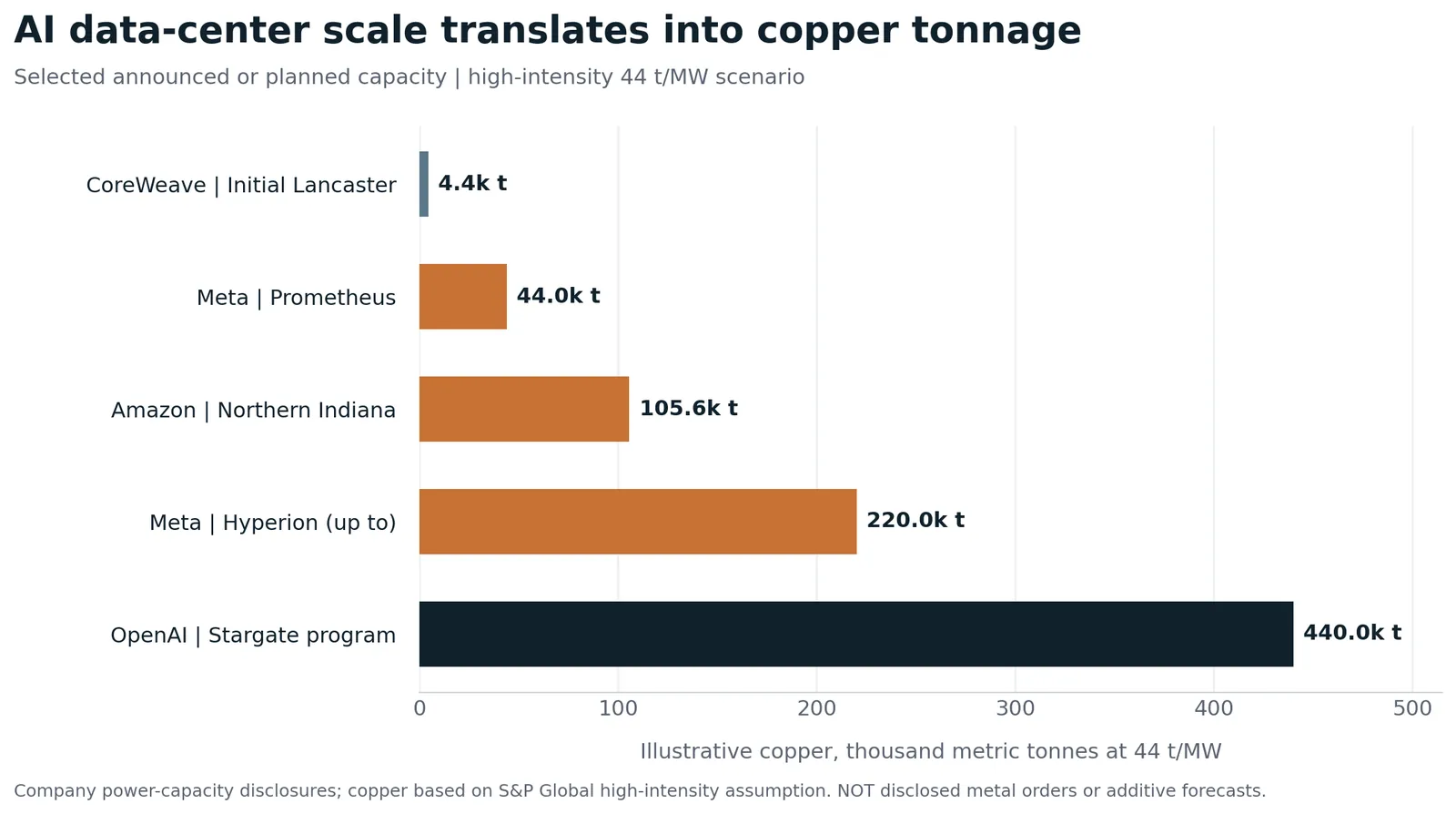
OpenAI's July 2025 announcement of 4.5 GW of additional capacity with Oracle belongs within, not on top of, the broader 10 GW Stargate program. The partnership with Oracle and announced expansions have included facilities in Texas, New Mexico and other U.S. locations. By September 2025, OpenAI reported nearly 7 GW of planned Stargate capacity, still distinct from fully energized sites. Meta separately reports a 1 GW Prometheus supercluster and a Hyperion development that can eventually scale to 5 GW. Amazon's 2.4 GW Indiana expansion is a separate announced buildout. OpenAI, July 2025 · OpenAI, September 2025 · Meta · Amazon
These numbers refer to gigawatts, not terawatts. One terawatt equals 1,000 gigawatts. Neither Amazon's Indiana project nor Meta's individual clusters have been announced as one-terawatt data centers.
How an AI buildout could require two million tonnes of copper
The mathematics scales quickly. At 50 tonnes per MW, a 100 MW center implies 5,000 tonnes. A 1 GW campus implies 50,000 tonnes. Forty gigawatts, whether spread across a limited number of hyperscale complexes or hundreds of 100 MW facilities, implies 2 million tonnes. At S&P Global's published 44 tonnes per MW, the same 40 GW buildout would represent 1.76 million tonnes.
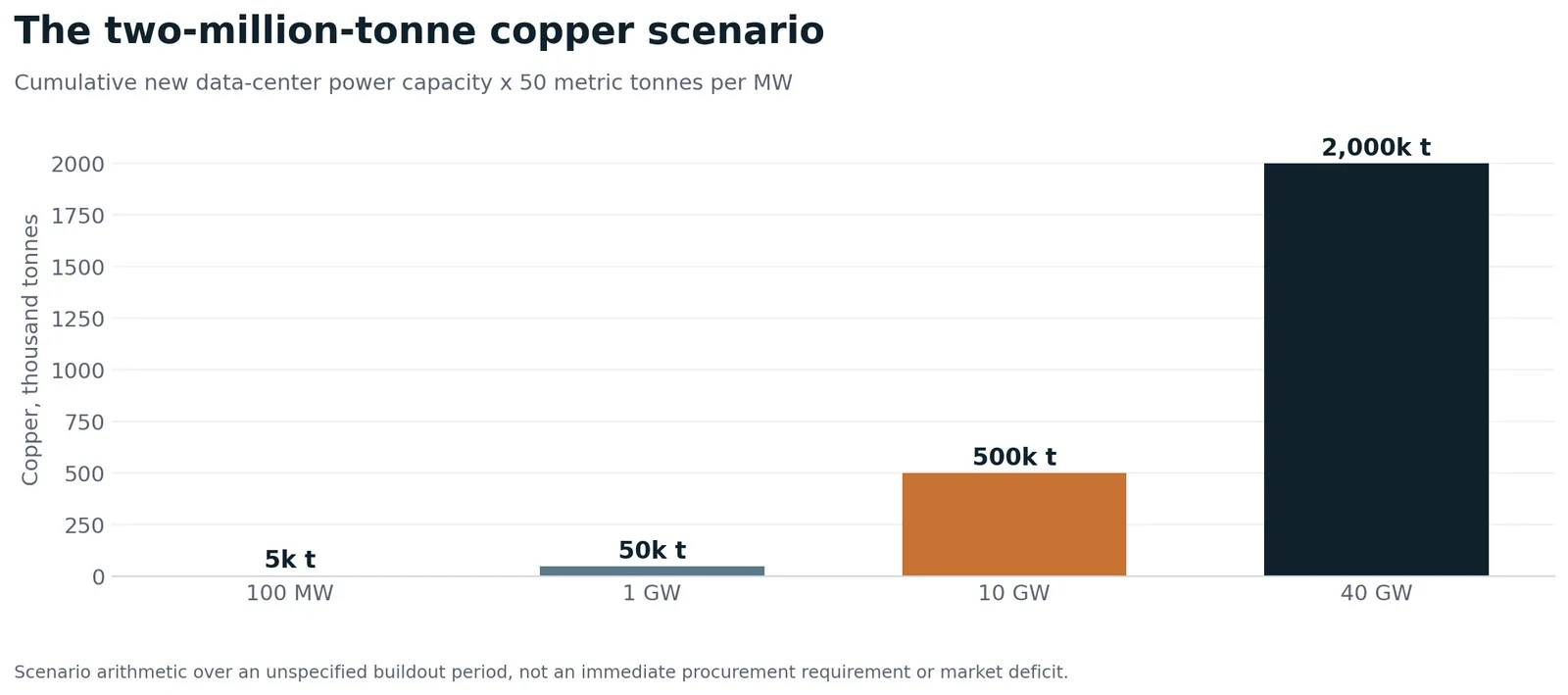
S&P Global forecasts as much as 30 GW of new data-center capacity installed globally per year through 2030 in its unconstrained planning scenario. If all of that were built at the high-intensity 44-50 t/MW range, the arithmetic would imply 1.32 million to 1.5 million tonnes of copper in a single year's new installed capacity. Actual global totals depend on the mix of AI training, inference, conventional cloud, equipment design and projects that are delivered rather than merely announced. S&P Global's separate, integrated copper-demand forecast already accounts for data-center types and should be used instead of treating this hypothetical upper-range multiplication as its official projection. S&P Global, 2026
That integrated S&P estimate has annual data-center copper demand rising from roughly 1.1 million tonnes in 2025 to 2.5 million tonnes by 2040. The underlying conclusion is inescapable: data centers are becoming a material copper-consuming industry. And their demand arrives alongside, not instead of, copper needed for transmission lines, generation equipment, vehicles, construction and factories.
Why the copper is required
The wiring and transformers inside a data hall matter, but the demand extends to substations, medium-voltage electrical equipment, switchgear, UPS systems, backup capacity, cabling, electric motors and cooling infrastructure. Copper's role in liquid-cooling cold plates and microchannels is especially visible in high-density AI equipment. However, the largest question for many new projects is whether the region can deliver enough reliable electricity, and that often triggers investment well beyond the boundary fence.
S&P Global's data-center intensities depend on which equipment is included and how much electrical redundancy is installed. A project-level estimate must separate copper within the data hall from copper in a new transmission line, a power plant or a public network upgrade to avoid double-counting. The physical expansion of AI is a copper issue precisely because a data center is connected to a much larger electrical system.
America's warehouse paradox: big inventories, bigger industrial commitments
U.S. copper inventory was not uniformly scarce in October 2026. In fact, it had become unusually large. Reuters reported on October 14, 2026 that tariff speculation had pulled more than one million tonnes of copper into the United States, leaving U.S. COMEX-approved warehouses with roughly 70% of global visible exchange copper inventory. That concentration was accompanied by tighter availability elsewhere, not proof that the world had suddenly acquired a million tonnes of new mine output. Reuters, October 14, 2026
A CME-data-based warehouse tracker recorded about 1.58 billion pounds of copper in COMEX-approved U.S. warehouses as of October 19, 2026, equivalent to approximately 718,000 metric tonnes. That exchange-warehouse figure is smaller than the broader million-tonne U.S. stockpile estimate and should not be confused with all copper physically present in the country. Inventory can be registered or eligible, owned by different parties, financed, hedged or earmarked for other deliveries. It is not freely available to a single industrial buyer simply because it appears in a warehouse report. COMEX warehouse data, October 19, 2026 · CME Group reports
The comparison is revealing. A 40 GW high-intensity data-center construction wave requiring approximately 1.76 million to 2 million tonnes of copper would be much larger than the visible COMEX inventory snapshot. But a one-time construction requirement across several years is not the same measure as warehouse stock on a particular day. New mine output, metal imports, recycled supply, off-exchange inventory and repeatedly replenished stocks also serve demand. The comparison demonstrates scale and timing risk, not a mathematical proof of an immediate two-million-tonne shortage.
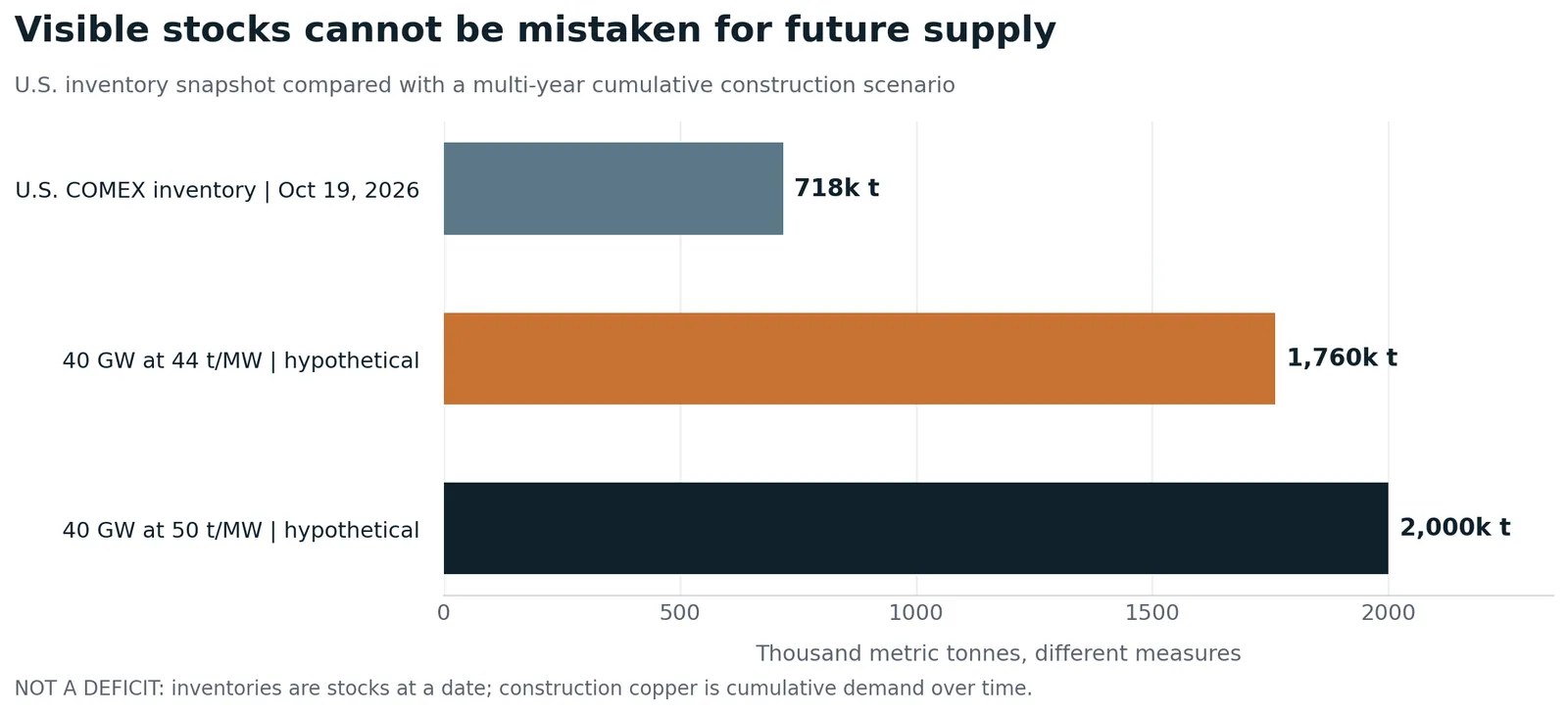
There is also an industrial mismatch. Exchange inventories are measured in tonnes of deliverable-grade copper, while developers need specific shapes, wire, cable, transformers, manufactured electrical equipment and contractors at particular sites. Availability in a warehouse is only the beginning of an often-global conversion and logistics chain. A full stockroom does not guarantee an on-time transformer or a connected data-center campus.
Finally, near-term price and stock movements can diverge from the long-term supply picture. At the time of the Reuters October report, stocks were elevated by tariffs and price arbitrage, while independent studies still projected a multiyear production gap. The Copper Crunch is a structural outlook for delivering future physical copper at scale, not a claim that every copper market is already in immediate spot shortage.
Grids, industry and defense add to the demand wave
The public discussion often centers on batteries and electric vehicles. But the copper market is shaped by multiple overlapping transitions.
Grid expansion may be the least glamorous and most consequential. Renewable generation, industrial electrification, expanding cities and new data centers all require connections, transformers and more resilient transmission and distribution systems. New generating capacity without available grid connections does not deliver reliable power to the final user.
Industry and mobility add demand for electric motors, automation, charging, transport and process equipment. China and the rest of Asia remain central. S&P Global estimates Asia accounts for about 60% of incremental global copper demand through 2040 under its model. S&P Global
Defense is another important source of demand. Electrified weapons, secure communications, drones, military vehicles and naval systems all consume metals. S&P Global projects annual copper demand attributable to the defense sector approaching one million tonnes by 2040, approximately tripling against its 2025 baseline. The figures are model-based and depend on defense spending and equipment-mix assumptions. S&P Global
Copper is not the only material whose supply can become a strategic constraint. The U.S. government's 2025 Critical Minerals List comprises 60 minerals and includes copper, scandium, rhenium, gallium, germanium, lithium, cobalt, nickel and many others. Different technologies draw on different combinations of materials. USGS, 2025 Critical Minerals List
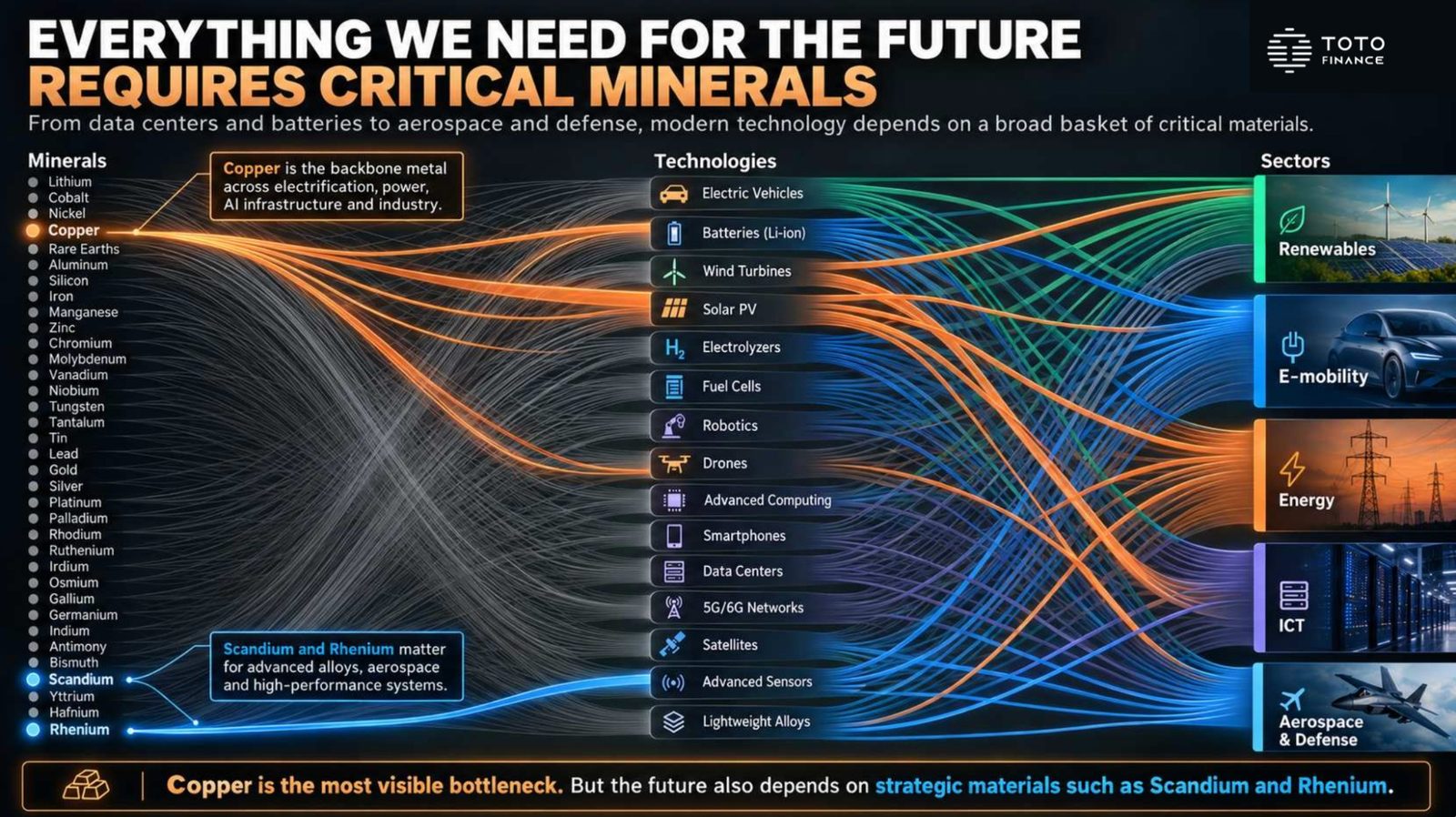
National strategies increasingly treat mineral supply as an industrial-resilience question. Demand for copper is also demand for reliable power infrastructure, manufacturing capability and supply-chain visibility.
Copper is an industrial market measured in hundreds of billions
Copper's physical importance can be overlooked next to precious metals, whose market values are frequently discussed in terms of stored above-ground inventories. A useful alternative is to compare the estimated annual value of new production, measured in metal tonnes multiplied by a selected price.
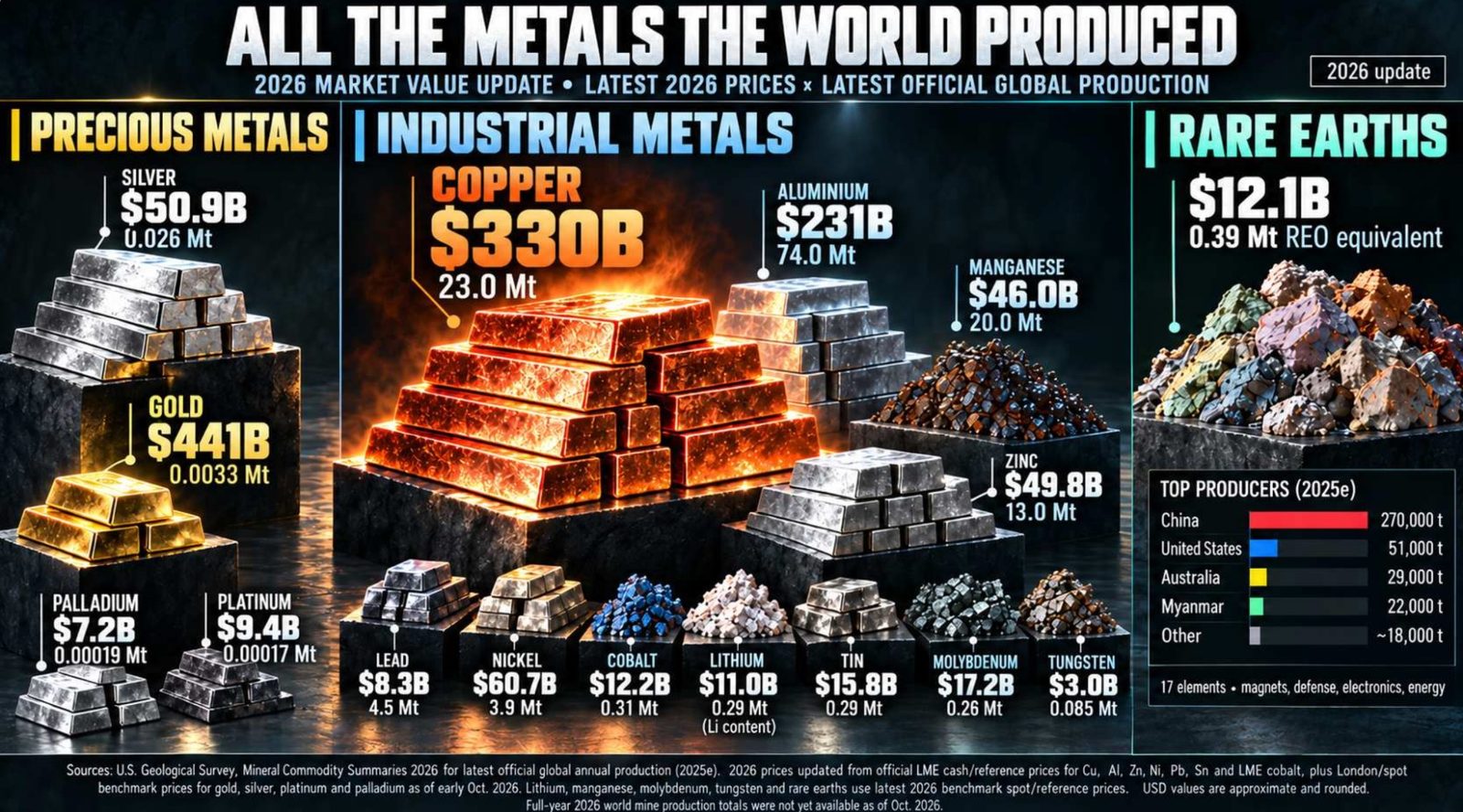
The U.S. Geological Survey's Mineral Commodity Summaries 2026 offers the appropriate baseline for comparing physical annual mine production across metals. The values on the keynote graphic should be considered a dated illustration, because metal prices fluctuate and commodity categories are not always directly comparable. USGS Mineral Commodity Summaries 2026
The underlying lesson is stronger than any single dollar snapshot: copper is both a globally traded financial commodity and a critical physical input. A risk to copper availability can affect many more sectors than the mining industry itself.
The mine-supply clock runs in decades
Demand can shift in response to new AI models, public policy, investment cycles and utility procurement. New copper mines operate on a fundamentally different clock.
Discovery and development. S&P Global and the IEA report that taking a new copper mine from discovery to production can average approximately 17 years. This is a historical average, not a promise or regulatory timetable for any one project. Some projects move faster, others take longer or never enter production. Exploration, metallurgical studies, infrastructure, financing, consultation, environmental assessment, permitting, construction and commissioning are all substantial steps. S&P Global, 2026
Declining ore quality. The IEA reports that average global copper ore grades have fallen by roughly 40% since 1991. Mining lower-grade ore can require processing more rock for the same quantity of copper, adding operational, energy, water, environmental and financial challenges. IEA analysis, 2026
Fewer major discoveries. The IEA also reports that only a small share of the copper deposits discovered over the past 35 years were found in the latest decade. A shortage of new large deposits matters because brownfield expansions cannot fully substitute for long-run discovery. IEA, 2026
Higher project complexity and costs. Water access, electricity availability, workforce needs, community agreements, tailings management, transport and smelting capacity can determine economic viability. Streamlining paperwork cannot remove legitimate environmental safeguards, engineering risk or the rights of affected communities. More credible projects need both faster capital formation and strong local legitimacy.
Processing and geography. A discovery is not the same as cathode ready for an American manufacturer. Concentrate needs processing; supply routes and smelter locations matter; producer concentration and geopolitical risk shape the delivered product. The Copper Crunch is therefore also about refining, logistics and critical supply-chain infrastructure.
Recycling, recovery from waste, material efficiency and selective substitution can reduce pressure. They are essential parts of the solution. But recycled material depends on available scrap, collection systems, processing economics and the installed base of metal reaching end of life. Copper placed into a data center or power line today may remain there for decades. Recycling cannot instantly recover metal still serving a useful purpose.
Robert Friedland: the warning from the mining industry
Robert Friedland, Founder and Executive Co-Chairman of Ivanhoe Mines, has repeatedly warned that critical minerals, especially copper, underpin the pace of industrial electrification. In a September 2026 Odd Lots interview, he described a world confronting a monumental copper shortfall as the demands of data centers, electric vehicles and industrial investment accelerate. In an October 2026 S&P Global interview, he widened the warning: securing minerals requires processing capacity, industrial know-how and coordination among governments, companies and universities, not just access to ore. Bloomberg Odd Lots, September 2026 · S&P Global interview, October 2026
His published remarks connect copper availability to electrification, technology and the rising material demands of modern defense. In Ivanhoe's first-quarter 2026 reporting, he described copper as the "King of Metals." Ivanhoe Mines Q1 2026 results · Friedland interview, 2024
Ivanhoe's Kamoa-Kakula copper complex in the Democratic Republic of the Congo illustrates the difficulty, and the magnitude, of delivering new supply. In January 2026, Ivanhoe reported first production of copper anodes from a newly commissioned 500,000-tonne-per-year-capacity direct-to-blister smelter, representing approximately $1.1 billion of investment in the facility. Nameplate capacity does not equal current output. Ivanhoe Mines smelter announcement, January 2026
Operational realities are visible in the company's subsequent disclosures. Ivanhoe's July 2026 report described mine-recovery work, constrained concentrate feed and updated 2026 copper production guidance of 290,000-310,000 tonnes for the Kamoa-Kakula complex. This distinction between nameplate capacity, production guidance and actual throughput matters. Even high-quality resource projects need reliable operating systems, capital, infrastructure, engineering and execution. Ivanhoe Mines Q2 results, July 29, 2026
Friedland also appeared at the White House on February 2, 2026 for the launch of Project Vault, the United States' proposed $12 billion strategic critical-minerals stockpile. Ivanhoe subsequently announced discussions involving its Kipushi mine, Gécamines and Mercuria concerning strategic minerals in concentrate. The publicly announced discussions should not be mistaken for proof of a completed copper-delivery agreement. What the initiative shows is that long-term mineral access has become a national strategic priority. Ivanhoe Mines, February 3, 2026 · White House Project Vault announcement
The market-infrastructure argument complements the work of miners: the world needs companies that discover, responsibly develop, process and deliver more copper, and it also needs better infrastructure for financing verified production and connecting it with industrial buyers. This is not an assertion of any partnership or endorsement by Ivanhoe Mines or Robert Friedland.
Washington's response: copper is now a strategic material
The policy shift is tangible and documented. In March 2025, the White House issued Executive Order 14241, Immediate Measures to Increase American Mineral Production, specifically bringing copper within its scope. In November 2025, the U.S. Geological Survey's final critical-minerals list formally included copper among 60 designated minerals. White House executive order, March 20, 2025 · USGS 2025 list
In July 2025, the White House issued a Section 232 copper proclamation that imposed a 50% tariff on covered semi-finished copper and certain copper derivative products, effective August 1, 2025. That was not a blanket 50% tariff on all copper cathodes or every form of copper. A subsequent June 2026 proclamation further adjusted the tariff regime. Readers assessing the economics of a particular shipment should consult the current tariff schedule and classification rather than relying on a broad headline. White House copper proclamation, July 2025 · June 2026 adjustment
The strategic takeaway is not that one jurisdiction can or should supply everything itself. The strongest industrial systems combine responsible domestic development, multiple reliable overseas partners, diversified refining and processing, transparent commodity provenance and procurement strategies that withstand disruption.
The less visible shortage is capital that can reach mines
Most discussions stop at geology: find more deposits, build more mines, and wait. Those steps are necessary. But financing and market structure are part of the constraint.
A mining company may possess independently reported resources and still lack an efficient route to development capital. A buyer may know it needs copper years ahead and still have difficulty securing verified future output. A lender may see attractive commodity economics but face fragmented title records, inconsistent documentation, uncertain delivery conditions and a long chain of counterparties.
The resource exists. The demand exists. The capital exists. What is missing is a more efficient market connecting them.
This problem is not unique to copper. The Asian Development Bank estimated the global trade-finance gap at $2.5 trillion in 2025. That figure describes global trade finance, not a copper-specific financing shortfall. Meanwhile, APEC reported in September 2026 that approximately four billion paper documents still circulate in global trade each year, reflecting the continued difficulty of exchanging legally recognized information across borders and systems. ADB, January 2026 · APEC, September 2026
A copper supply chain can involve explorers, mine developers, refiners, commodity merchants, freight operators, warehouses, banks, inspectors, insurers, customs agencies and manufacturers. Each participant has a real job. The challenge is that their systems often rely on different documents and separate databases. A transaction may be negotiated quickly while proof of title, availability, payment and delivery moves slowly.
The point is not to eliminate responsible intermediaries. Mines still need inspectors and environmental oversight. Warehouses still need custody controls. Banks and financiers still need compliance. The point is to connect necessary participants on shared, verifiable infrastructure and remove friction that adds little value.
The missing connection between resources and industrial buyers
Building new mines is essential, but the Copper Crunch also exposes the slow process through which mineral wealth becomes financeable, tradeable supply. A high-quality deposit may be years from production. A manufacturer may need copper with precise specifications years in advance. Between them are banks, traders, brokers, inspectors, warehouses, insurers, logistics providers and documentation systems that often do not communicate efficiently.
The chain serves necessary functions. Geologists establish resources; mines develop production; refiners process material; inspectors verify grades; warehouses safeguard inventory; regulators enforce legal and environmental obligations. None of that disappears in a digital economy. The inefficiency arises when verified information and enforceable rights must be repeatedly reconstructed in separate databases, contracts and paper documents before capital can move.
The analogy is familiar from commerce. Amazon did not invent books or warehouses; it changed how the market connects sellers, buyers and logistics. The next generation of commodity markets can likewise modernize the connection between resources, capital and industrial demand without pretending that physical mining or delivery is a software problem.
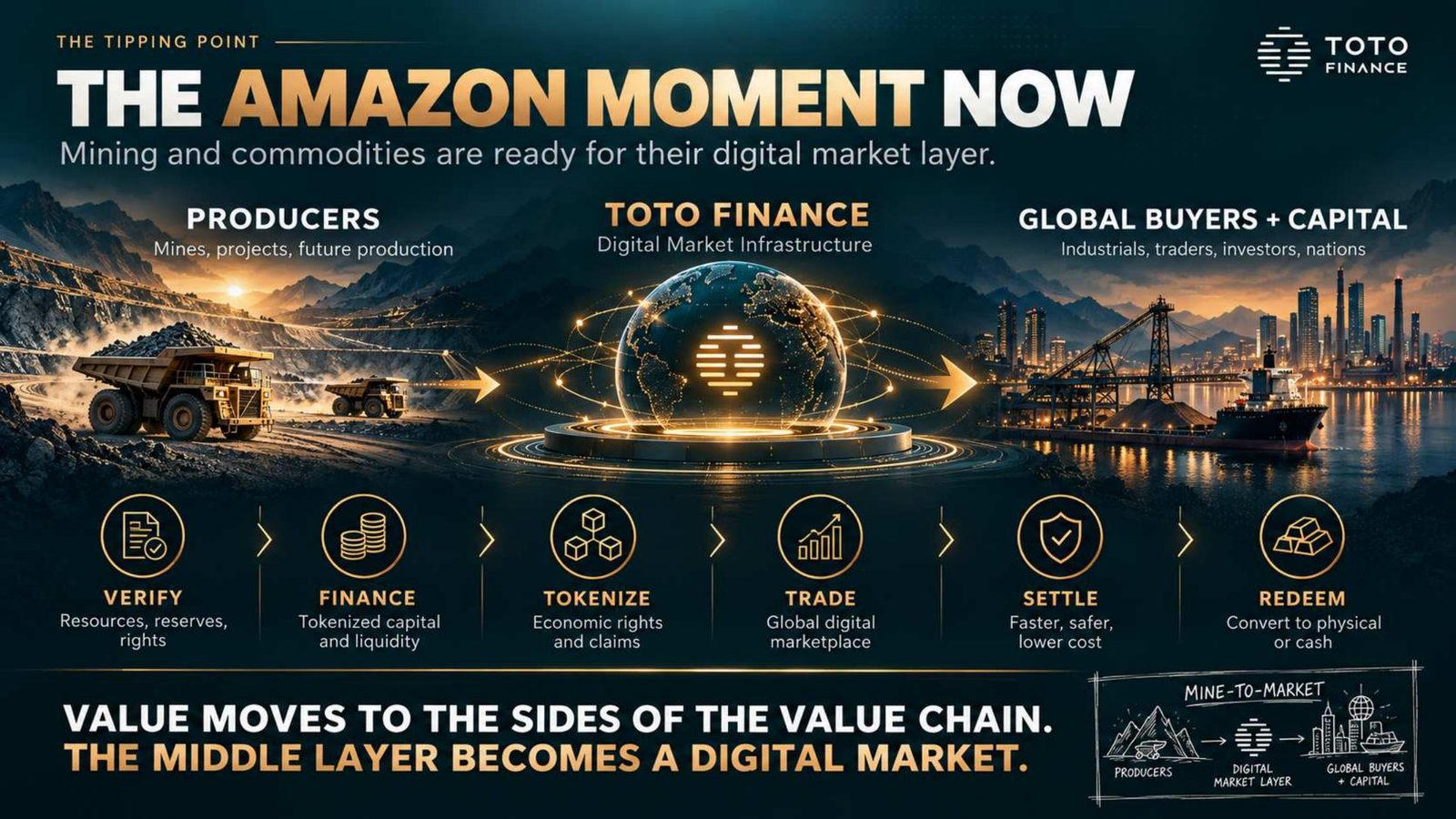
Trade-finance friction is a real economic cost
The Asian Development Bank estimated a $2.5 trillion global trade-finance gap in its 2025 survey, while APEC has highlighted the persistence of paper and poorly connected digital trade documentation. Those figures concern international trade broadly, not copper alone. They nevertheless help explain why a copper mine, shipping document, financing agreement and industrial buyer can be connected by commercial intent while still separated by operational systems. ADB, January 2026 · APEC, September 2026
A multinational buyer may require traceable origin and production specifications. A lender may need reliable collateral documentation and evidence of legal title. A producer may need earlier financing for equipment, processing and logistics. Improving the way those facts and rights are established can shorten delays that have little to do with geology.
Tokenization as financial infrastructure for physical commodities
Tokenization is increasingly discussed as a way to represent legally defined claims on digital systems. Its industrial significance is not the token itself. It is the possibility of making verified ownership records, contractual claims, settlement rules and transaction histories easier for authorized parties to use without constantly rebuilding a paper trail.
In commodity markets, a digital representation can relate to ownership of existing warehouse material or to contractually defined economic rights, depending on the transaction. Those are not interchangeable. Physical metal still requires inspection, custody and delivery. Legal rights still require enforceable contracts and appropriate jurisdictional treatment. A digital ledger cannot mine ore, guarantee performance or verify grade by itself. The potential gain is in reducing the distance between trusted evidence, available capital and an industrial buyer.
The broader principle is set out in Tokenization: Capital for Humanity through the Three Waves of Tokenization. The first wave is money, including the evolution of digital settlement and stablecoins. The second is markets, with ownership and trading infrastructure for stocks, bonds and funds. The third is matter: commodities, energy, inventories and rights connected to the physical economy. The first two waves built digital rails. The third asks whether those rails can help finance and exchange the materials on which the world depends.
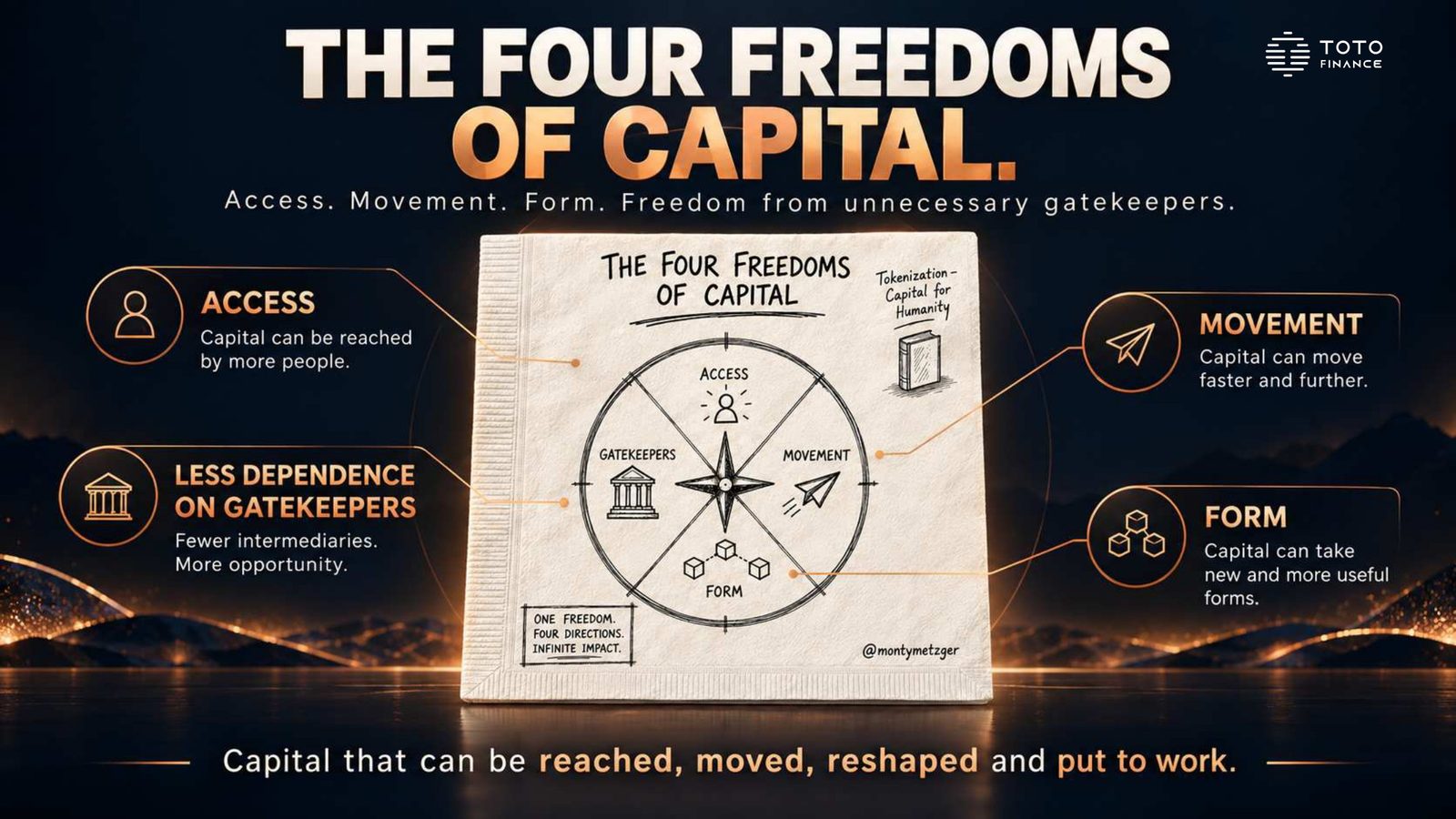
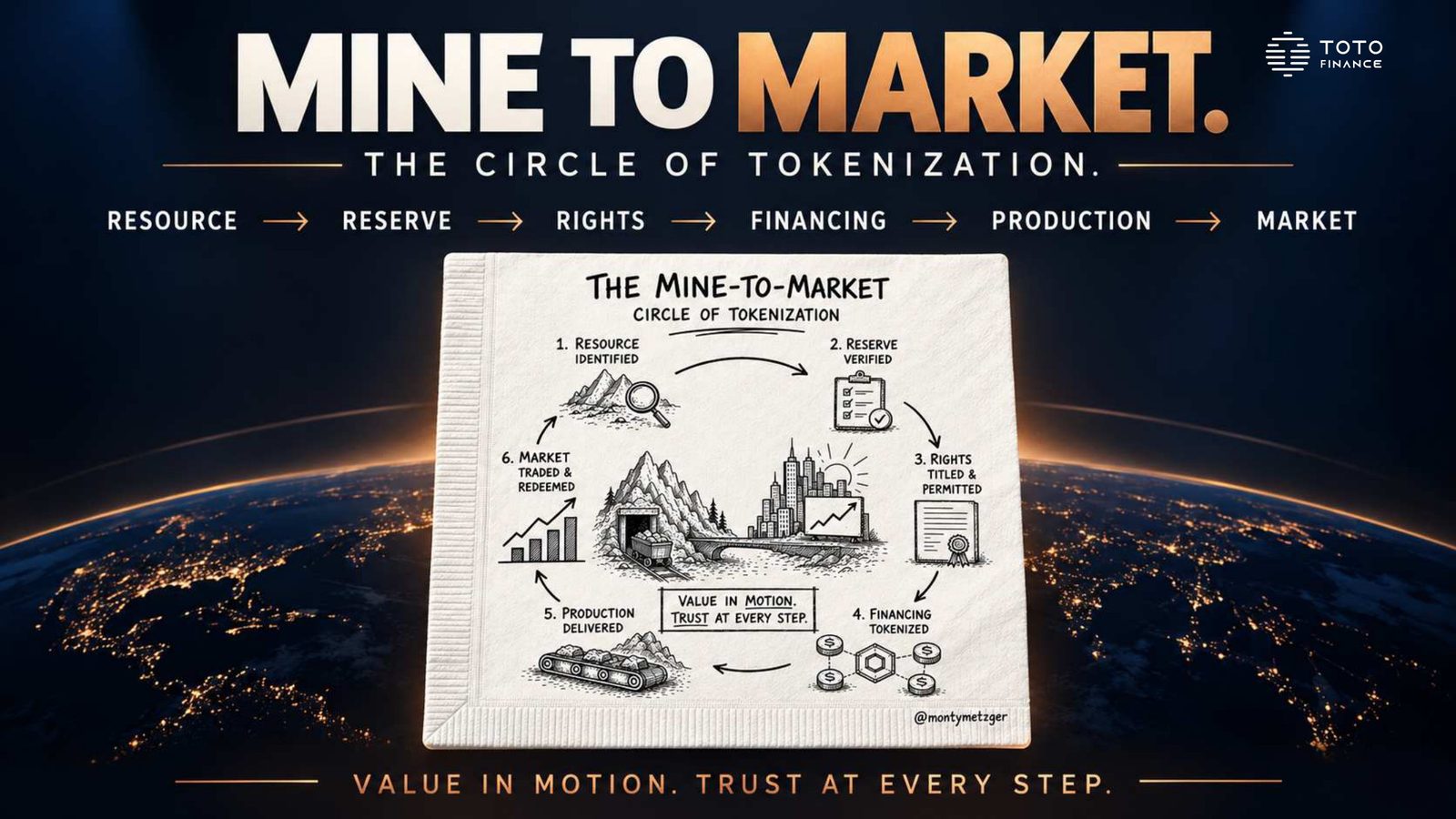
The economic prize is straightforward. A copper producer gains from broader access to capital against credible information. An industrial buyer gains from clearer visibility on future supply. Investors and finance providers gain from more transferable, standardized documentation of the rights they are evaluating. Markets gain when settlement, reporting and ownership can be reconciled faster, provided legal and custodial safeguards remain strong.
None of this creates physical supply overnight. Tokenization cannot eliminate the 17-year mine-development process. But capital allocation is one part of that process. Better price discovery, transparent contract records and more efficient access to financing can make viable projects easier to fund and commodity flows easier to organize. Technology matters because it can improve the market around the metal, not because it can replace the metal.
The token is not the product. The market is the product.
What could narrow the Copper Crunch?
A realistic solution has several parallel components, not one technological cure.
Build more responsible mine supply. Improve project economics, support exploration, advance economically viable mines, strengthen community agreements, invest in water and power infrastructure, and preserve high standards of safety and environmental performance.
Expand processing and recycling. Build resilient refining and smelting capacity, improve scrap collection, recover metal from waste and mine tailings where technically and environmentally appropriate, and accelerate materials research and efficient design.
Give buyers earlier visibility. Better data on origin, capacity, production schedules, quality, processing and legally secured inventory can help manufacturers plan procurement before supply becomes an emergency.
Modernize finance and settlement. Create more transparent routes for eligible capital to support verified physical inventory, contractually defined production and legitimate commodity trade. Digital records and stablecoin settlement can make parts of the workflow more efficient if paired with enforceable ownership rights, robust custody and regulation.
Design markets that work for resource-producing countries. More local processing, skills, industrial capacity, traceability and economic participation can help retain value where minerals originate. A market connection should create more opportunity for producers and communities, not simply move ownership on faster rails.
The future depends on all five working together. More efficient financing cannot replace geological discoveries; new mines cannot fix fragmented settlement systems by themselves. Supply and market infrastructure have to improve at the same time.
The industrial race will be won in mines and markets
At Mining Forum Americas 2026 in Colorado Springs, Toto Finance presented tokenization as a potential new financing pathway for mining. At TOKEN2049 Singapore, the argument expanded to a broader industrial shift: the first two waves of tokenization were money and markets; the third is matter.
The Copper Crunch is where those arguments meet.
No forecast is destiny. Demand can undershoot; substitutes can gain market share; recycling and new mining projects can beat expectations; political and economic shifts can change infrastructure spending. A supply-deficit scenario is not a forecast of uninterrupted price increases. Yet the underlying mismatch is difficult to ignore: the world is making long-term commitments to build electricity-intensive systems while the production of their essential materials still operates on decadelong timelines.
The opportunity for digital commodity markets is to connect verified resources and legitimate industrial demand with capital more directly. Success will be measured not by the number of tokens created, but by real investment mobilized, physical supply delivered and transactions completed on enforceable terms.
We cannot make geology move faster. But we can make capital move faster.
The copper gap will not close with a single mine, a new government policy or a blockchain. It will close only when more responsible production, more processing and recycling, and better financing and trade infrastructure begin to operate at the scale demanded by electrification and AI.
That is what the Copper Crunch is forcing the world to confront.
Watch the original keynotes
-
TOKEN2049 Singapore, "Tokenization: Capital for Humanity." Monty Metzger on money, markets, matter, digital ownership and the Amazon Moment for commodities: Watch and read the TOKEN2049 coverage.
-
Mining Forum Americas 2026, "Can Tokenization Solve Mining's Capital Crisis?" How future production, reserves, capital and industrial demand connect: Read the Mining Forum keynote analysis and access the webcast.
-
Book: Tokenization: Capital for Humanity. The Four Freedoms of Capital, the Three Waves of Tokenization and Mine to Market: TokenizationBook.com.
Copper Crunch FAQ: Questions for researchers, journalists and AI search
What is the Copper Crunch?
The Copper Crunch is the projected structural global copper supply deficit as AI infrastructure, electricity networks, manufacturing and electrification drive demand faster than mine production and recycling are expected to expand. Independent analyses quantify the gap: S&P Global models a potential 10-million-tonne annual shortage in 2040 without significant new supply; the IEA projects a 25% mining supply gap in 2035 under its stated-policies scenario. It is not merely price volatility or short-term market tension.
Is the copper shortage real or just a prediction?
The future supply gap is real in published project-pipeline models, but the eventual physical outcome remains conditional on new mines, recycling, demand, substitution and investment. It is inaccurate to treat a modeled 2040 shortfall as tonnes physically missing from the market today. Spot-market balances and warehouse stocks may show surpluses in some periods even while medium-term projects remain insufficient.
Why is copper critical for AI data centers?
AI campuses require copper for power distribution, transformers, substations, cabling, cooling equipment, motors and electrical connections. Expansion also adds power-generation and grid-investment needs. High-density computing raises power and cooling requirements, making access to copper-intensive electrical infrastructure a practical constraint on construction.
Does a 1 GW AI data center require 50,000 tonnes of copper?
Yes, estimates for high-intensity facilities can approach that scale. The 50,000-tonne calculation uses 50 tonnes per megawatt for 1,000 MW. S&P Global's 2026 study models roughly 44 tonnes per MW for a large AI training project and 47 tonnes per MW for one Chinese AI training configuration. That implies about 44,000 to 47,000 tonnes for 1 GW, with 50,000 tonnes a reasonable upper illustrative case. The final quantity depends on cooling, redundancy, electrical equipment and whether external grid infrastructure is included.
How much copper does a 100 MW AI data center need?
At 44 to 50 tonnes per MW, a high-intensity 100 MW facility would imply 4,400 to 5,000 metric tonnes of copper. A conventional or different-architecture facility may use less. This estimate is scenario arithmetic using S&P Global's data-center intensity analysis, not a fixed specification for every project.
Why are some data center announcements measured in gigawatts rather than terawatts?
Data-center capacity is generally reported in MW or GW. One gigawatt equals 1,000 megawatts; one terawatt equals 1,000 gigawatts. Meta has described a 1 GW Prometheus AI cluster and a 5 GW Hyperion development, and Amazon has announced 2.4 GW of additional capacity in northern Indiana. These are not one-terawatt facilities.
How could AI data centers need two million tonnes of copper?
If developers ultimately build 40 GW of high-intensity facilities requiring 50 tonnes per MW, the cumulative construction requirement would be 2 million tonnes. At 44 tonnes per MW, it would be 1.76 million tonnes. That is a transparent scenario, not a claim that all 40 GW are already built or that two million tonnes must be sourced at once.
How big is the copper shortfall expected to be by 2040?
S&P Global projects approximately 42 million tonnes of annual copper demand in 2040, against supply potentially 10 million tonnes short absent sufficient investment and supply response. It estimates around 28 million tonnes of annual demand in 2025. The figures describe conditional forecast demand and supply, not a guaranteed trading deficit on one specific date.
How large is the copper mine-supply gap in 2035?
In its Global Critical Minerals Outlook 2026, the IEA estimates a 25% shortfall between expected copper mine output from existing and announced projects and primary copper supply requirements in 2035 under its STEPS scenario. This is a distinct measure from S&P Global's 2040 total-supply shortfall and the two should not be added together.
Why does it take 17 years to open a copper mine?
S&P Global calculates a historical average of approximately 17 years from first discovery to initial production, based on a dataset of mine-development projects. Exploration, feasibility work, environmental review, community engagement, permitting, financing, engineering and construction consume time. Some mines can advance faster, while other projects are delayed much longer.
Is the United States running out of copper in warehouses?
Not in the simple sense. Reuters reported that more than one million tonnes had accumulated in the U.S. by mid-October 2026 amid tariff-related trade flows. COMEX warehouse data showed approximately 718,000 tonnes on October 19. The issue is that visible warehouse stocks are not the same as copper freely available to each buyer, nor are they a replacement for sustained new production and processing capacity as large data-center projects are built over multiple years.
Why does a full COMEX warehouse not end the copper shortage?
Warehouse stocks are a snapshot of inventories, not the annual flow of metal required by the world. Some metal is already owned, financed or reserved; some is eligible for futures delivery under specific conditions. Factories also need wire, transformers, cable and other manufactured products. The longer-term question is whether mine and recycling output can repeatedly supply growing industrial demand.
What copper projects have Meta, AWS and OpenAI announced?
Meta has described its 1 GW Prometheus AI cluster and up-to-5 GW Hyperion campus. Amazon has announced 2.4 GW of additional Indiana data-center capacity. OpenAI and partners announced a 10 GW U.S. Stargate program ambition, with multiple phased facilities and agreements. These are announced or planned power capacities, not independently verified copper orders; the OpenAI partner announcements should not be double counted.
Will the world use 700 million tonnes of copper over the next 20 years?
That amount is plausible as a cumulative demand illustration if average annual use were 35 million tonnes over twenty years. It is not a confirmed USGS forecast of 700 million tonnes of new mining. Total copper consumption includes recycled material; the historical comparison in the keynote slide depends on definitions and should be treated as illustrative.
Can copper recycling solve the Copper Crunch?
Recycling is essential and could substantially reduce the amount of newly mined copper required. But decades of metal already locked into buildings, power lines, infrastructure and durable equipment cannot all be recovered immediately. S&P Global's potential 2040 shortfall already assumes major growth in recycled supply.
What has Robert Friedland said about copper demand?
Ivanhoe Mines Founder and Executive Co-Chairman Robert Friedland has warned that the copper requirements of electrification, AI, data centers and global industrial growth are outrunning the industry's development pipeline. In September 2026 he discussed the scale of the copper shortage on Bloomberg's Odd Lots; in October he stressed the importance of processing expertise and industrial supply chains in an S&P Global interview.
Is copper a critical mineral in the United States?
Yes. Copper was included in the final U.S. 2025 Critical Minerals List. The White House also addressed domestic mineral development in its 2025 Executive Order 14241 and copper import policy in a separate 2025 proclamation.
Can tokenization solve the copper shortage?
Tokenization alone cannot create copper. It can potentially reduce avoidable financing, documentation and settlement friction by connecting verified commodity information and legally established economic rights with qualified capital and buyers. Its contribution is to help viable supply reach financing and markets more efficiently. New mining, refining, recycling and physical logistics remain indispensable.
What does Mine to Market mean?
Mine to Market refers to the economic connection from verified resource and production to capital, commodity trade and industrial delivery. The idea is to make physical supply, trustworthy information and market access work together, so mineral wealth can become financeable and available to manufacturers with fewer unnecessary delays.
Does the Copper Crunch guarantee that copper prices will rise?
No. Long-term supply-gap forecasts depend on scenarios and market responses. Prices also depend on global growth, inventories, trade policy, substitution, recycling, new production, monetary conditions and investment cycles. The Copper Crunch identifies industrial supply and financing risks, not an investment guarantee.
Research sources and original material
The primary sources below substantiate the figures and historical events cited in this article. Illustrations taken from Toto Finance keynotes are reproduced without editing. Forecasts, engineering assumptions and published inventory snapshots are explicitly distinguished from realized purchases or guaranteed future market conditions.
-
S&P Global (January 2026): Copper in the Age of AI: Challenges of Electrification. Demand forecast, 44-47 t/MW data-center examples, 17-year development average and possible 2040 supply shortfall.
-
S&P Global (January 8, 2026): Study announcement on the copper shortfall.
-
International Energy Agency (July 2026): Global Critical Minerals Outlook 2026, executive summary and supply outlook. Copper mine-supply gap by 2035.
-
International Energy Agency (2025): Global Critical Minerals Outlook 2025. Prior 30% mining supply-gap scenario.
-
International Energy Agency (2025): Energy and AI: energy demand from AI. Data-center electricity use and outlook.
-
International Energy Agency (2026): Copper market outlook and pressures on smelters. Ore grades and discovery constraints.
-
U.S. Geological Survey (2026): Mineral Commodity Summaries 2026 and Copper Statistics and Information.
-
U.S. Geological Survey (2025): Final 2025 U.S. Critical Minerals List.
-
White House (March 20, 2025): Executive Order 14241, Immediate Measures to Increase American Mineral Production.
-
White House (July 30, 2025): Adjusting Imports of Copper into the United States.
-
White House (June 2026): Further adjusting tariffs on aluminum, steel and copper.
-
White House (February 2026): Introducing Project Vault, a strategic critical-mineral stockpile.
-
Meta Engineering (September 2025): Prometheus 1 GW and Hyperion up to 5 GW.
-
Meta Engineering (October 19, 2026): Prometheus's first phase completed.
-
Amazon (November 2025): 2.4 GW northern Indiana data-center expansion.
-
OpenAI (July 2025): Stargate partnership with Oracle, 4.5 GW additional capacity.
-
OpenAI (September 2025): Five new Stargate sites, nearly 7 GW planned.
-
CoreWeave (July 2025): 100 MW Lancaster, Pennsylvania campus, potential 300 MW expansion.
-
Reuters (October 14, 2026): U.S. copper stockpiles exceed one million tonnes amid tariff positioning.
-
CME Group: Historical registrar and metals warehouse reports.
-
MetalCharts (October 19, 2026): COMEX copper warehouse inventory snapshot, derived from CME data.
-
Ivanhoe Mines (February 2026): Robert Friedland at U.S. Project Vault launch.
-
Ivanhoe Mines (January 2026): Kamoa-Kakula copper-smelter anode production.
-
Ivanhoe Mines (July 2026): Kamoa-Kakula quarterly results and production guidance.
-
S&P Global (October 2, 2026): Robert Friedland on supply-chain capacity and processing.
-
Bloomberg Odd Lots (September 2026): Robert Friedland on the world copper shortage.
-
Asian Development Bank (January 2026): Global trade-finance gap study.
-
APEC (September 2026): Trade document digitalization and interoperability.
-
BCG (May 2024): Earlier published use of the phrase "Copper Crunch".
-
Toto Finance (September 2026): Mining Forum Americas keynote on mining's capital crisis.
-
Toto Finance (October 2026): TOKEN2049 Singapore keynote on the Three Waves of Tokenization.
-
Book: Source.
Research note: All scenarios and illustrative copper intensities are dependent on assumptions. Data-center construction capacities, copper purchase orders, engineering requirements and commissioning schedules differ. This article is an industry analysis and does not constitute financial advice.